








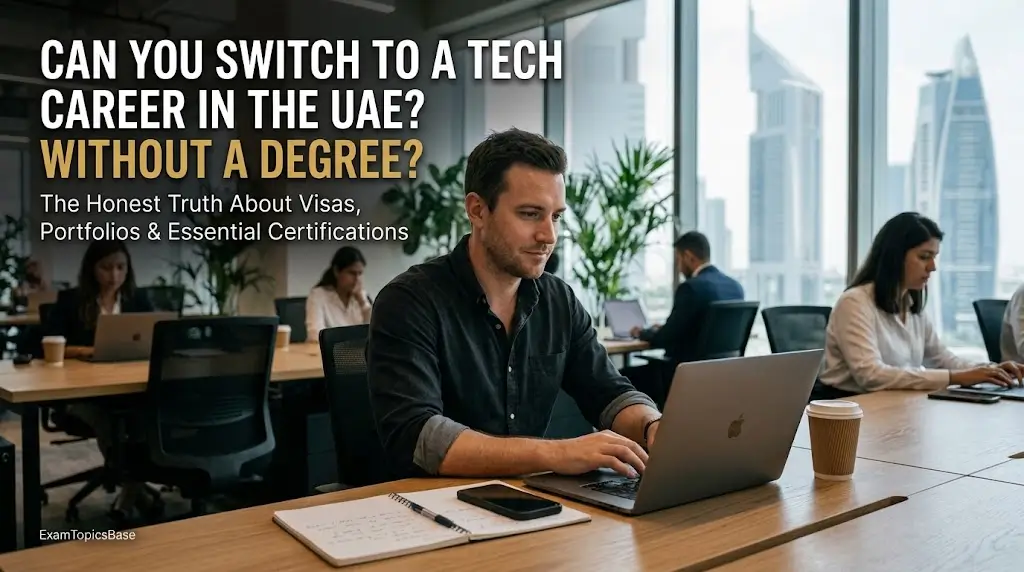
If you ask ten people on Sheikh Zayed Road whether you need a computer science degree to land a tech job in Dubai, five will tell you it is mandatory, and the other five will say nobody cares about college anymore.
Table Of Content
Both sides are half right, but they are talking about two completely different things: hiring culture versus visa regulations.
The short answer is yes, you can transition into tech in the United Arab Emirates without a technical degree—or even without a traditional four-year bachelor’s degree. However, doing so requires navigating strict immigration classifications, automated recruitment filters, and an intensely competitive local candidate pool.
Here is an honest breakdown of how the UAE market works, what the real legal and corporate hurdles are, and how self-taught or transitioning professionals pull it off.
The Reality Check: Visa Rules and MOHRE Classifications
Before worrying about coding interviews or cloud architectures, you need to understand how employment works legally in the UAE.
The Ministry of Human Resources and Emiratisation (MOHRE) categorizes jobs into distinct skill levels:
- Skill Level 1: Professional, executive, and specialized engineering roles. These typically require an attested bachelor’s degree (or equivalent) to secure that exact designation on your residency visa and labor card.
- Skill Levels 2 & 3: Technicians, associate specialists, administrative, and operations staff, which require post-secondary diplomas or high school certificates.
The Workaround Companies Actually Use:
If a startup, agency, or mid-sized tech consultancy in Dubai wants to hire you as a full-stack developer or cloud support specialist, but you only hold a non-technical degree (like business, arts, or commerce) or a diploma, they can still legally sponsor you.
Often, your internal role and day-to-day duties will be “Software Engineer” or “DevOps Associate,” while your official MOHRE visa title might be processed under an open administrative or technical specialist designation that matches your attested papers. Free zones (such as Dubai Media City, DTEC, or DMCC) also offer companies substantial flexibility in hiring talent based on demonstrable skills rather than rigid diploma matching.
What UAE Hiring Managers Actually Look For
The UAE does not suffer from a shortage of job applicants; it suffers from a shortage of verified, plug-and-play competence.
Because thousands of professionals fly into Dubai every month on tourist visas hoping to switch careers, hiring managers are exhausted by generic resumes claiming “passionate learner” or “tech enthusiast.” If you do not have a formal CS degree, you have to replace that credential with unmistakable proof of capability.
1. Verifiable Public Proof
If you are transitioning into web or mobile development, your GitHub profile and live deployed applications are your real degree. A recruiter in Dubai would rather click through three responsive, fast-loading web applications solving real business problems than read through a list of online courses you watched on 1.5x speed.
2. Specialized Industry Certifications
When you do not have a four-year technical parchment, standardized vendor credentials act as your primary equalizer. A Cisco CCNA, AWS Solutions Architect, or CompTIA Security+ badge proves that your technical knowledge adheres to vendor-approved industry standards. It gives an HR screener a quantifiable metric to justify shortlisting you over a university graduate.
3. Real Commercial Transition Points
The easiest path into UAE tech is rarely a straight leap into senior engineering. It is through bridge roles:
- IT Support / Helpdesk: A proven entry point where communication and practical troubleshooting trump formal engineering degrees.
- QA & Software Testing: High demand across regional e-commerce, banking apps, and logistics platforms.
- Technical Sales / Customer Success: If you have prior experience in sales or account management, tech firms eagerly hire people who understand both client relationships and software setups.
The 3 Mistakes Career Switchers Make in Dubai
If you want to make this career transition work, avoid these common traps:
- Mass-Applying to Legacy Multinationals First: Giant traditional corporations and government departments have strict procurement and HR bylaws that mandate attested four-year degrees just to get an interview pass. Target agile startups, regional IT consultancies, and digital agencies first.
- Relying Only on Basic Bootcamps: Completing a 12-week course is a good start, but in a talent pool flooded with experienced expats, you need practical lab experience and real-world deployment skills to compete.
- Ignoring the “Visit Visa” Timeline: Landing a job from scratch in 60 days without a technical background is brutal. Build your portfolio, pass your core credentials, and network with UAE tech communities online before burning through short-term travel budgets.
Getting Ready for Your Transition
To make yourself an undeniable candidate without a tech degree:
- Build public, documented projects that solve practical problems.
- Focus on in-demand Gulf niches: Cloud operations, cyber defense, or enterprise infrastructure.
- Validate your technical foundation by earning globally respected vendor credentials.
Passing tough certification exams requires structured discipline, especially if you are learning foundational concepts from scratch. Platforms like ExamTopicsBase help career switchers benchmark their knowledge with structured exam blueprints, scenario-based practice questions, and active discussion forums so you can walk into your exam center ready to pass on your first attempt.




No Comment! Be the first one.